
November 3, 2026
Cursor Pricing Explained: Plans, Usage Limits, Overage Costs
 Taran Srivastava · 16 min read
Cursor costs $0, $8, $30, $100 or $200 a month as of October 2026, and since 12 October it is sold inside The X Subscription alongside Grok and X Premium. The plan price buys a weekly pool of Grok and Composer usage only. Claude, GPT, and Gemini are billed on top at API list price from the first request, so the real cursor pricing question for most AI engineers is how many third-party tokens their agents burn each week.
This guide walks through every plan, how the weekly limit drains, what overage costs per model, and where the bill grows faster than the sticker price suggests. It ends with the steps teams use to keep AI coding spend predictable.
TL;DR
- Premium at $30 a month is the cheapest Cursor plan that can run Claude or GPT, and none of that third-party usage is included.
- Usage now resets weekly and is shared with the Grok apps, so image generation or Grok Bot work eats into coding time.
- Ultra gives twice the pool per dollar of Plus, but only if you use the extra capacity before the weekly reset.
- On Teams plans, a flat $0.25 per million tokens applies to cached tokens too, which makes it the largest single line on cache-heavy Sonnet sessions.
- If you are on a legacy Pro or Pro+ plan and mostly run Claude, switching is permanent and drops your included third-party allowance.
What every Cursor plan costs in October 2026
Cursor now has five individual tiers plus Teams and Enterprise. Each tier is defined by how big its weekly pool is relative to Plus, and whether it can reach third-party models at all.
| Plan | Monthly | Annual | Weekly pool | Third-party models |
|---|---|---|---|---|
| Free | $0 | n/a | Limited | Not available |
| Plus | $8 | $80 | 1x (base) | Not available |
| Premium | $30 | $300 | 4x Plus | API list price, prepaid |
| Super | $100 | $1,000 | 15x Plus | API list price, prepaid |
| Ultra | $200 | $2,000 | 50x Plus | API list price, prepaid |
| Teams | $30 / $100 / $200 per seat | Not listed | Matches seat tier | List price plus $0.25 per 1M tokens |
| Enterprise | Custom | Custom | Pooled | List price plus $0.25 per 1M tokens |
Prices exclude tax. A few details decide which row fits you:
- Plus is a Grok-only plan. It runs Grok 4.7, 4.6, 4.5 and Composer 2.5 at fixed settings: Fast off, medium effort, 256k context. It has no Auto, cloud agents, Bugbot, Origin or bring-your-own-key.
- Premium is the real developer tier. It adds cloud agents, automations, Bugbot code review, Origin code hosting, Grok Bot and access to third-party models.
- Super and Ultra only add pool size. Super adds priority access at peak times, and Ultra adds earliest access to new models. Neither includes any Claude or GPT allowance.
The pricing card itself flags the third-party catch in small print at the bottom of each paid tier:
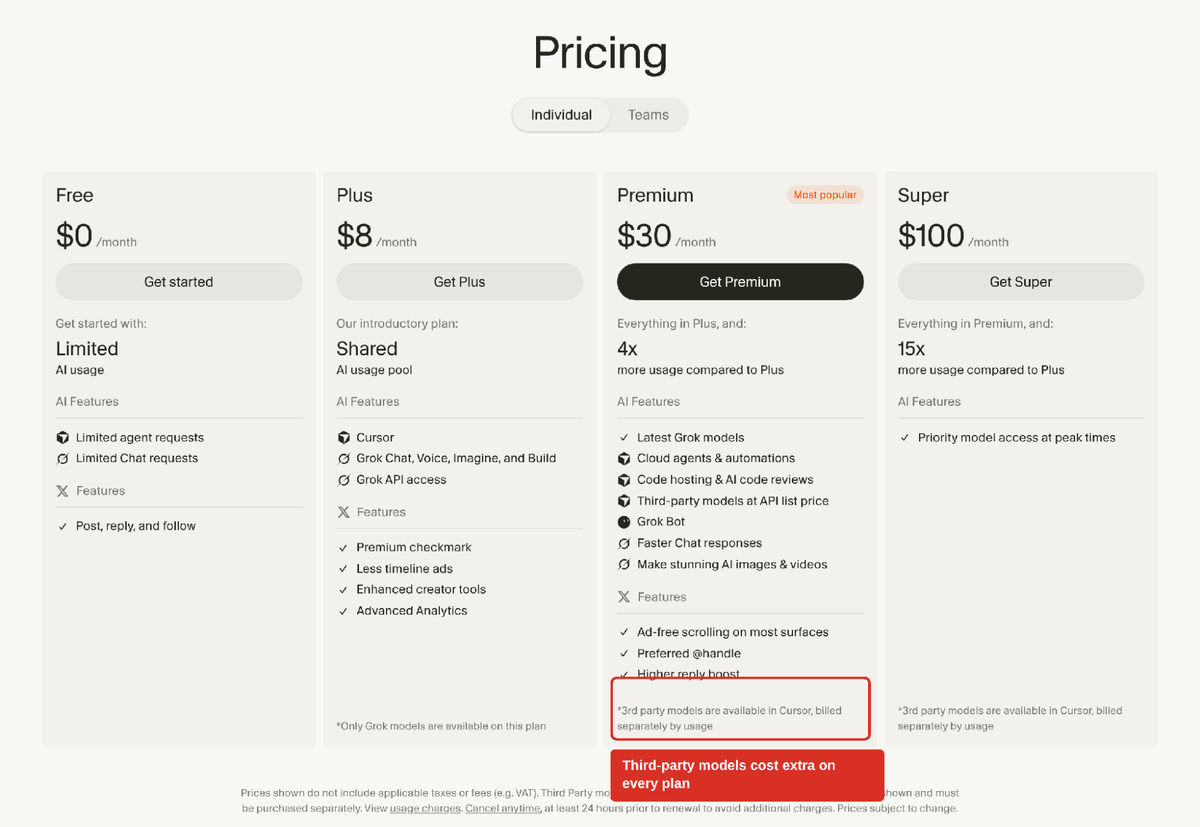
Cursor's pricing page lists third-party models as a Premium feature, with the footnote that they are billed separately. Source: cursor.com/pricing
Annual billing works out to two months free on every paid tier. Premium paid yearly saves $60, and Ultra saves $400.
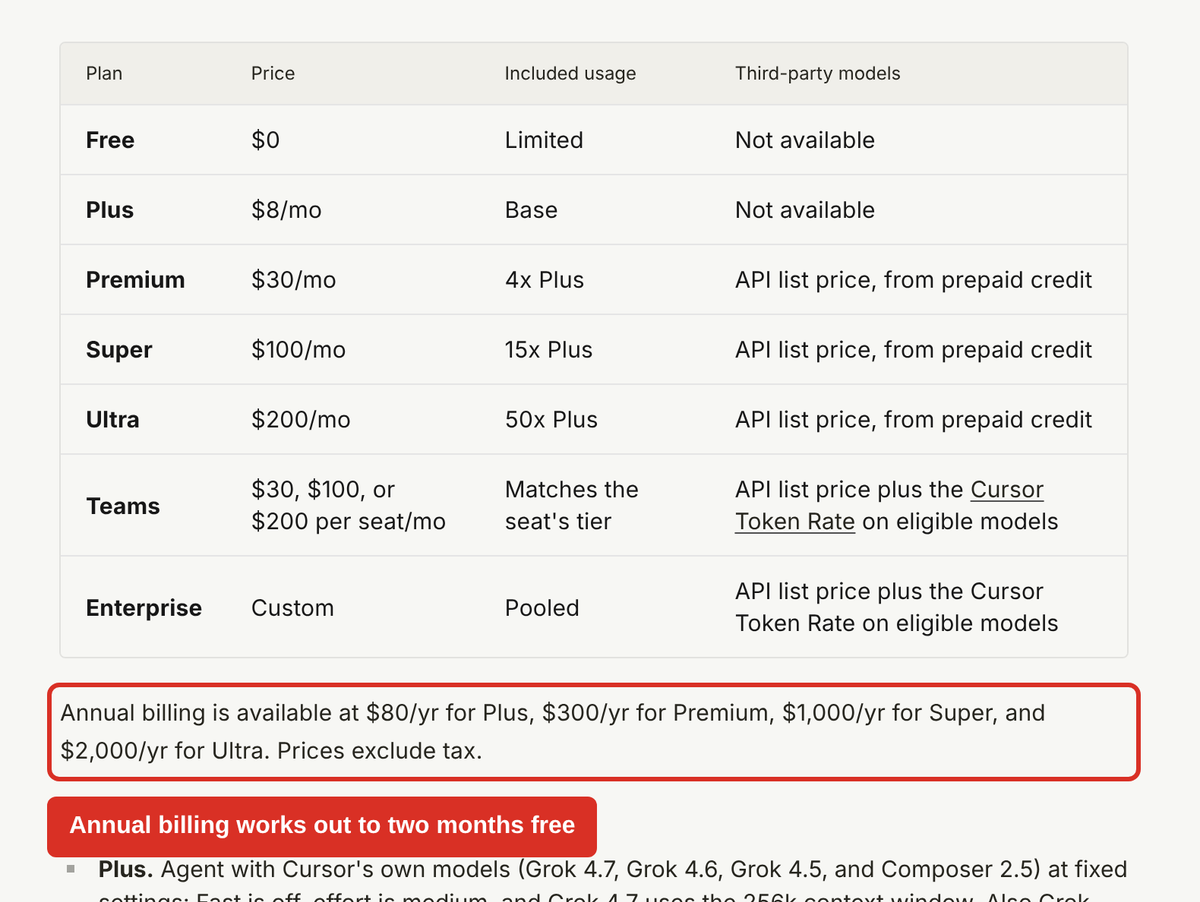
The annual prices sit in Cursor's docs, below the plans table. Source: Cursor Models & Pricing
What changed when Cursor moved into The X Subscription
Before 12 October, Cursor sold Pro at $20, Pro+ at $60, and Ultra at $200, each with two monthly pools: one for Cursor models and one called Other Models for Claude, GPT, and Gemini. Those plans still run for existing customers, but new sign-ups can only buy the new tiers.
Cursor maps each old plan to its closest new one:
- Pro at $20 maps to Premium at $30, a $10 increase.
- Pro+ at $60 maps to Super at $100, a $40 increase.
- Ultra stays at $200, but the new Ultra has no third-party allowance.
- Teams Standard drops from $40 to $30 per seat, and Teams Premium from $120 to $100.
Cursor says each new tier carries at least twice the Grok and Composer usage of the plan it replaces. The trade is the Other Models pool, which disappears on switching. The switch is also one-way.
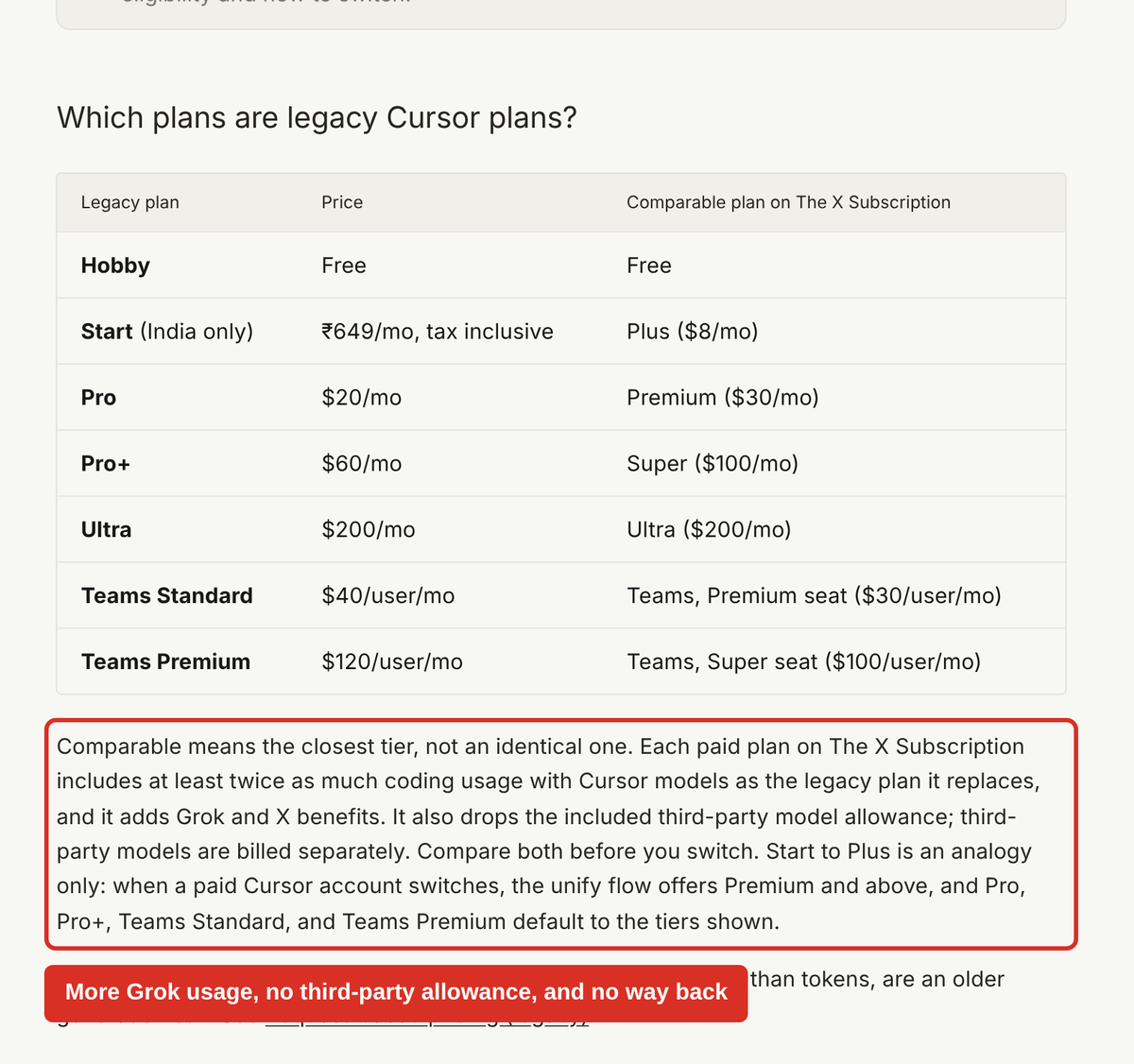
The old-to-new plan map, with the trade-off stated in the paragraph below the table. Source: Legacy Cursor plans
Teams come out ahead on seat price. Solo developers who lived on Claude through the old Pro plan are the group that pays more.
How the weekly usage limit drains
Every paid plan gets one pool of usage for Cursor's own models, and it refreshes weekly. Unused usage does not roll over. The pool is shared across Agent in the editor, the CLI, cloud agents, Grok Bot, and the Grok apps for chat, voice, and image generation.
Three things set how fast the pool empties:
- Model choice. Grok 4.7 Fast and the 500k-context variant draw at double the standard Grok rate.
- Context size. Agent sessions resend the repository context on every step, so long sessions burn far more than short chats.
- Non-coding use. An evening of Grok image generation comes out of the same pool your agents need on Monday.
Users are noticing the speed. On 29 October, a Premium subscriber posted that two prompts had used 10% of the weekly limit, and estimated the whole week would last about 20 similar prompts.
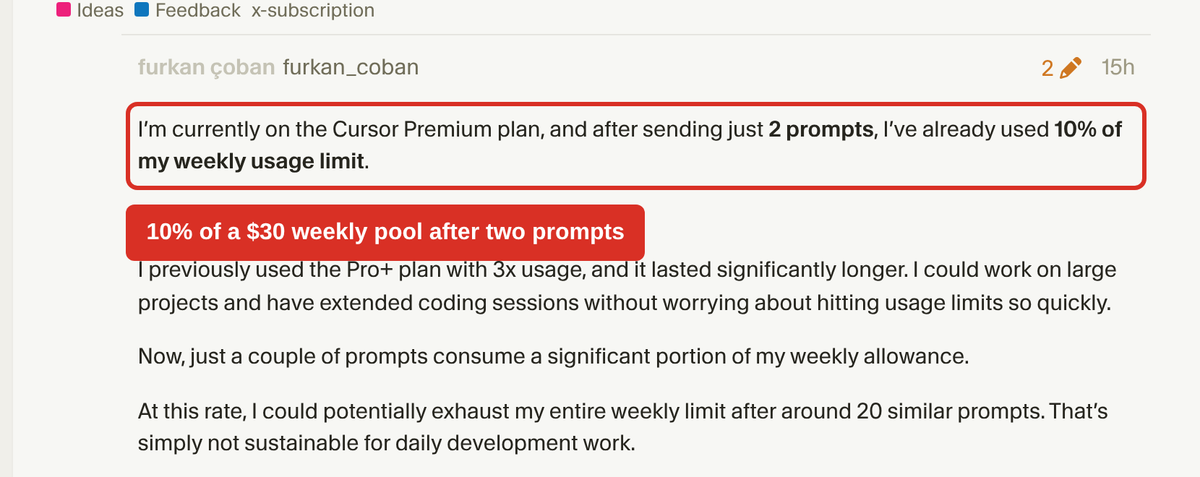
A Premium user reports 10% of the weekly pool gone after two prompts. Source: Cursor forum
Because the pool multiples grow faster than prices, the bigger tiers buy more usage per dollar. Plus gets 0.125 units per dollar, while Ultra gets 0.25, which is exactly double.
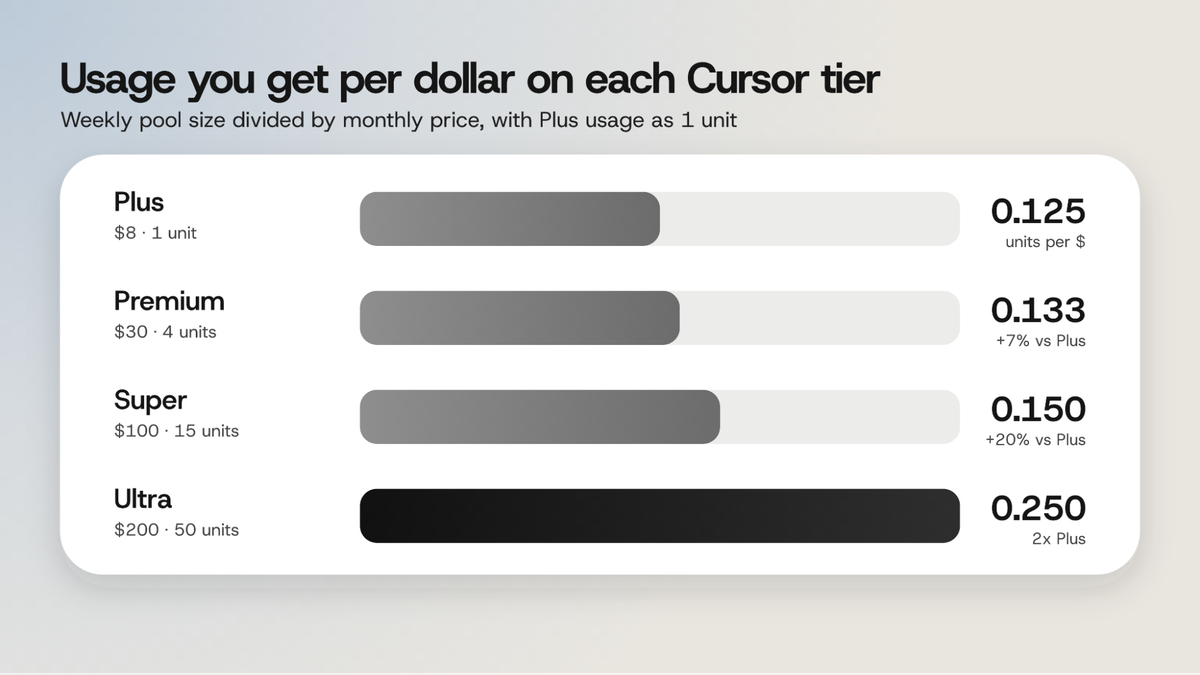
Usage per dollar across Cursor tiers, with the Plus pool counted as one unit.
The catch is the weekly reset. Ultra only beats Super on value if your agents use the extra pool every week. Unused capacity on a Sunday night is gone.
How third-party models get billed inside Cursor
Third-party models never touch the weekly pool. On Premium and above, every Claude, GPT or Gemini request is charged at the provider's API list price from your prepaid credit, starting with the first token.
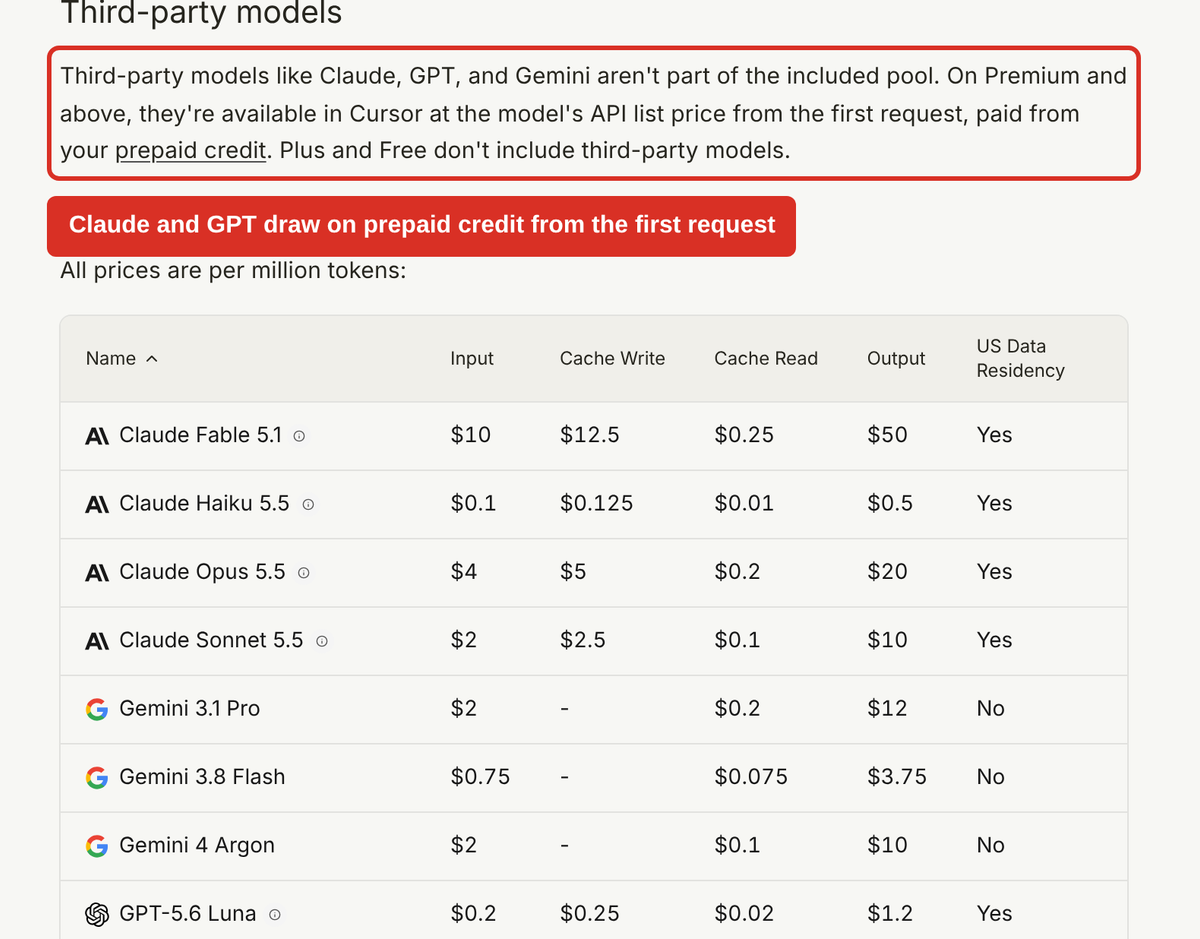
Cursor's docs confirm there is no included allowance for third-party models on any tier. Source: Cursor Models & Pricing
Cursor support confirmed what this means for heavy users. Asked whether a second $200 Ultra subscription would give more Claude Opus 5.5 usage, a Cursor support engineer replied that it would not, because the new Ultra includes no third-party usage at all.
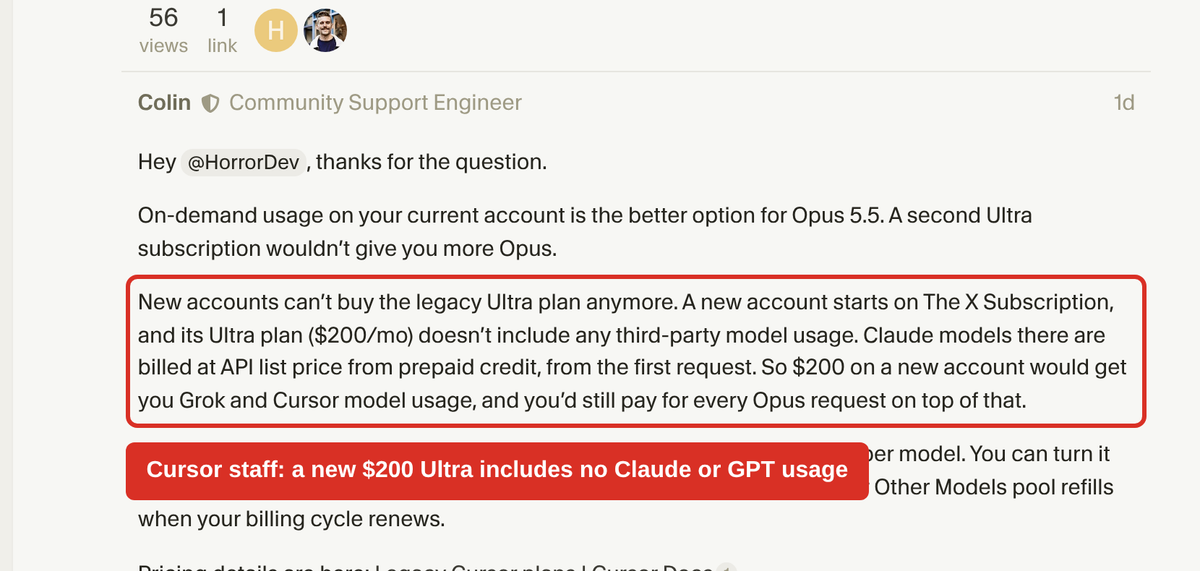
Cursor's community support engineer on what a new $200 Ultra plan includes. Source: Cursor forum
The per-model rates match each lab's own API price. The ones AI engineers reach for most, per million tokens:
| Model | Input | Cache write | Cache read | Output |
|---|---|---|---|---|
| Claude Opus 5.5 | $4 | $5 | $0.20 | $20 |
| Claude Sonnet 5.5 | $2 | $2.50 | $0.10 | $10 |
| Claude Haiku 5.5 | $0.10 | $0.125 | $0.01 | $0.50 |
| GPT-5.6 Sol | $4 | $5 | $0.40 | $20 |
| GPT-5.6 Terra | $2 | $2.50 | $0.20 | $12 |
| Gemini 3.1 Pro | $2 | n/a | $0.20 | $12 |
One more billing path catches people out. Subagents can call a named third-party model while the picker still shows Auto, Grok or Composer, and those calls bill as third-party usage.
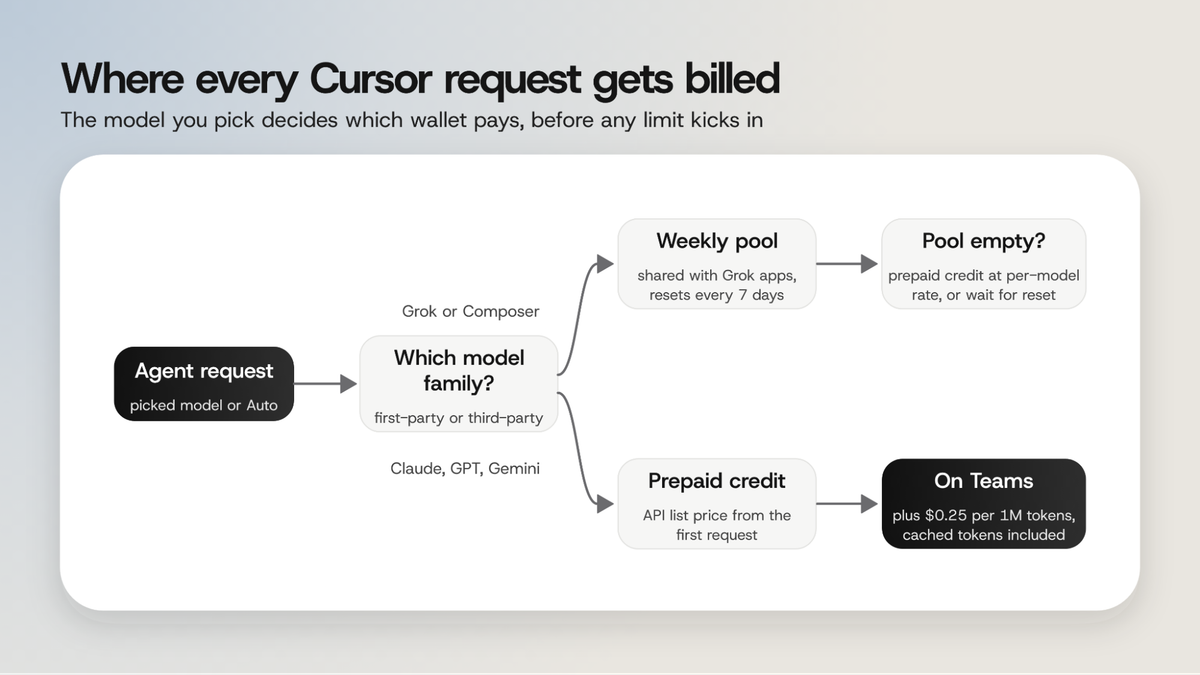
The billing path for a single Cursor request, from model choice to the wallet that pays.
For a deeper look at how Anthropic prices these same models outside Cursor, see our breakdown of Claude API pricing.
What overage costs once the weekly pool runs out
When the pool is empty, you have three options: wait for the reset, keep going on prepaid credit, or upgrade. Cursor states that requests are never downgraded in quality or speed. Overage on Cursor's own models is charged at these rates per million tokens:
| Model | Input | Cache read | Output |
|---|---|---|---|
| Grok 4.7 | $2 | $0.50 | $6 |
| Grok 4.7 (Fast) | $4 | $1 | $12 |
| Grok 4.7 500k (Fast) | $6 | $1.50 | $18 |
| Composer 2.5 | $0.50 | $0.20 | $2.50 |
| Composer 2.5 (Fast) | $3 | $0.50 | $15 |
Here is the detail most pricing write-ups skip. Grok 4.7 looks cheap next to Claude Sonnet 5.5 on input and output, but its cache read rate is $0.50, five times Sonnet's $0.10. Agent sessions are mostly cache reads because the same repository context is sent on every step.
Suppose we have a developer whose agents run 10M input tokens, 5M cache writes, 40M cache reads and 3M output tokens in a month:
- On Sonnet 5.5: $20 + $12.50 + $4 + $30 = $66.50.
- On Grok 4.7 beyond the pool: Grok lists no cache write rate, so those 5M count as input. That gives $30 + $20 + $18 = $68.
- On Composer 2.5 beyond the pool: $7.50 + $8 + $7.50 = $23.
So once you are past the weekly pool, Grok 4.7 costs about the same as Sonnet for agent work. Composer 2.5 is the one first-party model that stays cheap after the reset runs out, at roughly a third of either.
How top-ups cap your overage spend
- Top-ups add prepaid credit at grok.com/dashboard/billing. Each top-up expires 365 days after purchase.
- Auto Top-up refills credit when the balance drops below a threshold you set.
- Monthly additional usage limit caps paid usage no matter how much credit you hold. Set it before turning on Auto Top-up.
The Cursor Token Rate on Teams plans
Teams and Enterprise pay one extra charge individuals do not: a Cursor Token Rate of $0.25 per million tokens on eligible third-party models. It applies to input, output and cached tokens, and it also applies when you bring your own API key.
Cached tokens are where it bites. Sonnet 5.5 cache reads cost $0.10 per million, so the $0.25 rate turns each cached million into $0.35, three and a half times the list price. In the workload above, the rate adds $14.50 a month per developer, a 22% uplift on the Sonnet bill.
Three ways to avoid it:
- Use Cost mode in Auto, which is exempt.
- Route mechanical steps to exempt models, such as Claude Haiku 5.5, GPT-5.6 Luna or Gemini 3.8 Flash.
- Keep Grok and Composer as the default, since Cursor's own models never carry the rate.
How Cursor pricing compares with Claude Code, Codex
The comparison most AI engineers run is Cursor against the coding tools sold by the model labs. Claude Pro costs $20 a month, or $17 billed annually, and includes Claude Code. Claude Max costs $100 for 5x Pro usage or $200 for 20x, and since October also includes $100 or $200 a month in API credits.
ChatGPT Plus at $20 includes Codex, and the $100 ChatGPT Pro tier gives five times the Codex usage of Plus. Both flat plans stop or slow you at their five-hour and weekly limits instead of billing per token.
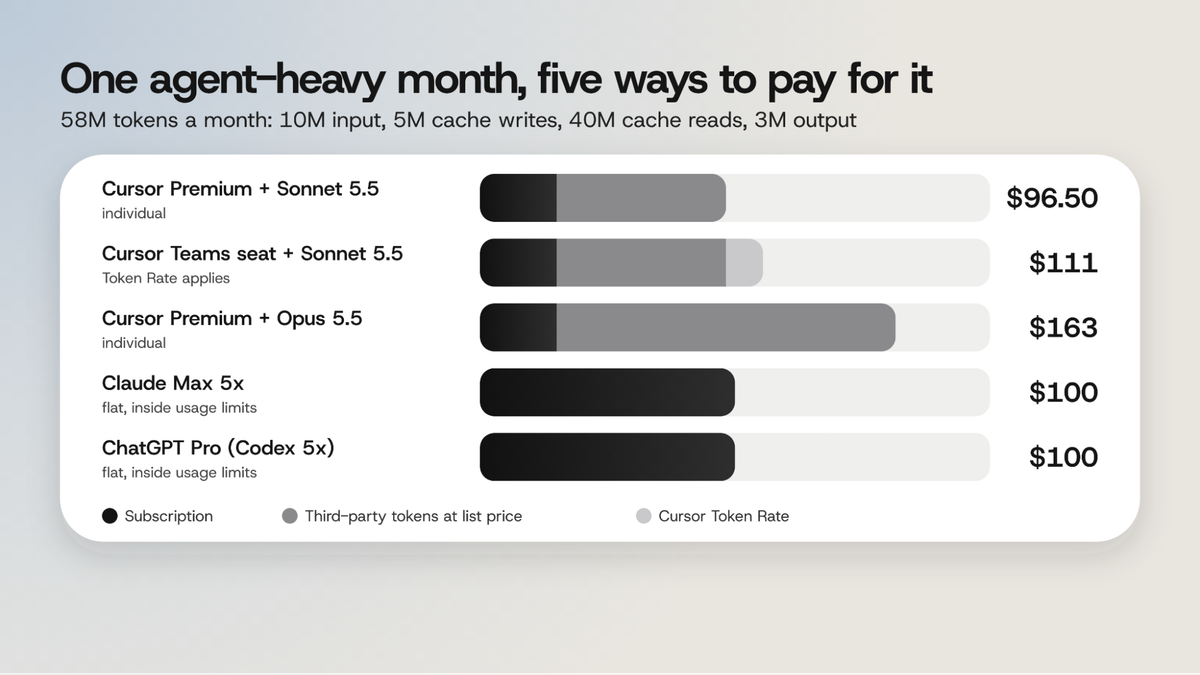
Monthly cost of the same agent workload across five setups, at October 2026 list prices.
For a developer who mostly runs Claude, a flat Max plan beats Premium plus Opus by $63 a month on this workload. Cursor wins when Grok or Composer covers most of the work, or when the team needs Cursor's editor features, Bugbot and cloud agents.
What developers on the Cursor forum say about the new plans
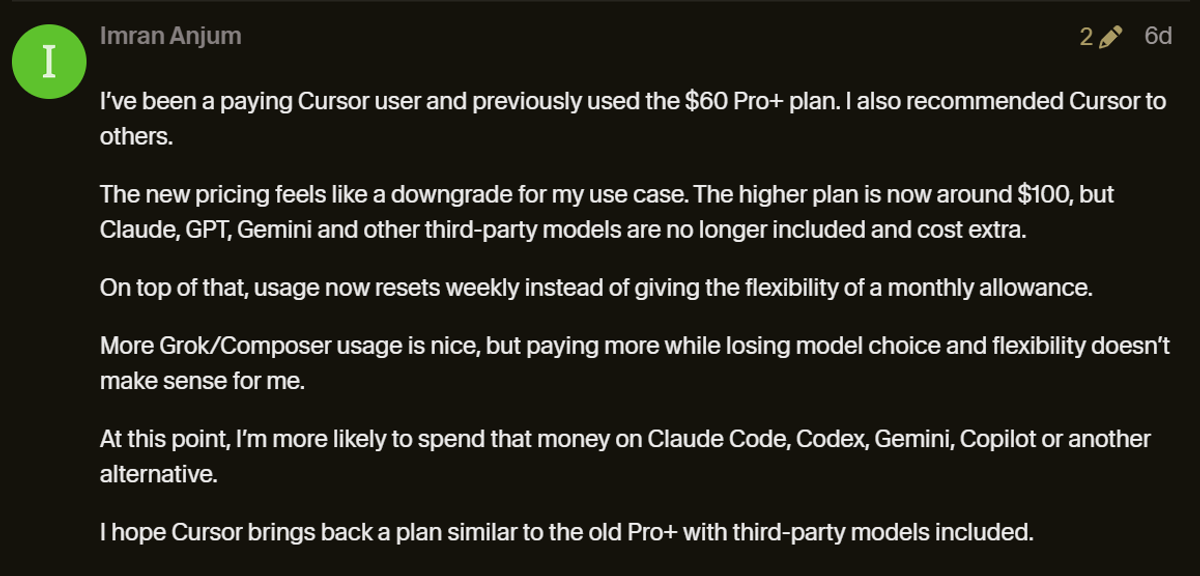
The launch thread passed 277 replies and 14,000 views within two weeks. The complaints cluster around three themes: model neutrality, weekly resets and silent plan changes.
"Cursor earned its place next to Codex and Claude Code not because of its own model, but because it was 'one editor where you can use the best models.'" — coco_max, long-time Ultra subscriber, 13 October 2026
"The higher plan is now around $100, but Claude, GPT, Gemini and other third-party models are no longer included and cost extra. On top of that, usage now resets weekly." — Imran_Anjum, former Pro+ user, in New X plan Pricing
"I've been paying $20 since the beginning and now that plan doesn't even exist but they've not even sent an email to us warning us about the change?" — deaniopo, 13 October 2026
There are fans too. A user summarising the change noted that developers who already code with Grok models gain quota, while those who rely on other models lose out. The split runs along model choice, which is why the decision tree below starts there.
Which Cursor plan to pick for your workload
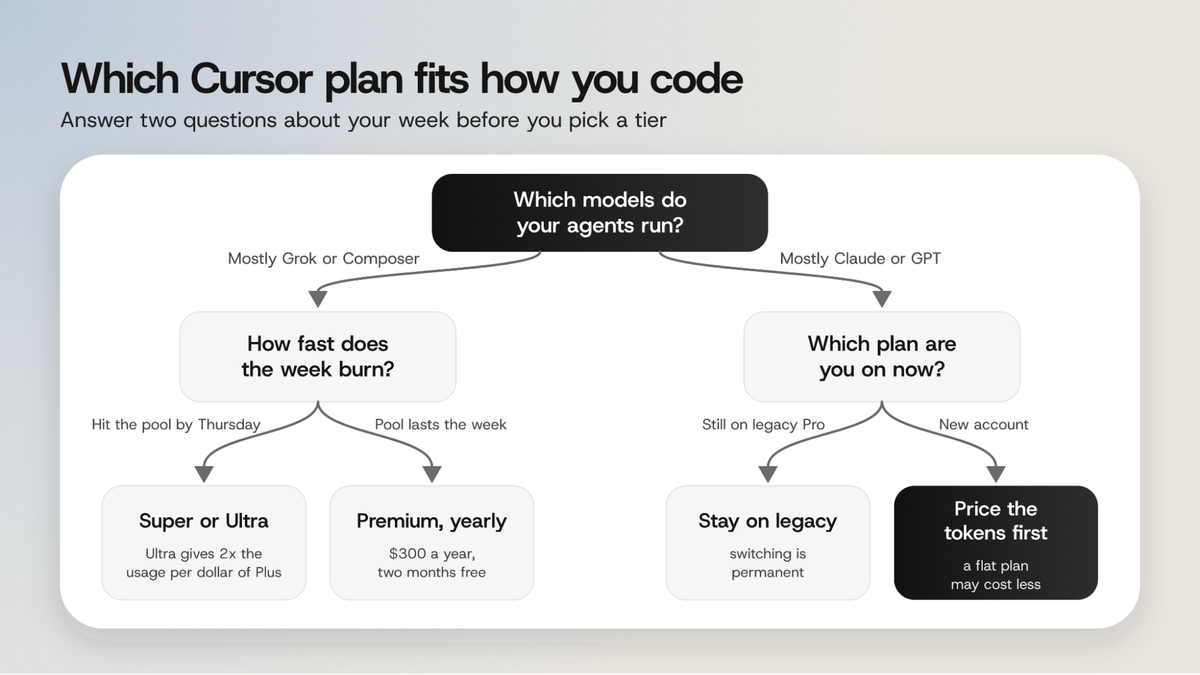
A two-question decision tree for choosing a Cursor plan.
- Trying it out: Free. Plus has no cloud agents, Auto or third-party models, so it is a weak test of the editor.
- Grok or Composer daily driver: Premium, paid yearly at $300.
- Hitting the pool mid-week: Super, then Ultra once your usage dashboard shows you would use the extra pool every week.
- Claude-first on legacy Pro: stay put. Your Other Models pool goes away the moment you switch.
- Claude-first on a new account: price your monthly tokens first, then compare Premium plus credit against a flat Claude Max plan.
- Team of 5 to 50: mostly Premium seats, a few Super seats for heavy agent users, and a team-wide monthly cap set on day one.
How engineering teams keep AI coding spend in check
Plan choice only sets the floor. The teams with predictable bills changed how they hand out access and route work.
Booking.com put spending tiers on access
Booking.com's cloud and AI FinOps team presented their program at FinOps X Amsterdam after spend on one AI provider curved upward from January to June. Their steps, in order:
- Built role-scoped dashboards first, so individuals, managers and VPs each saw their own spend.
- Created three tiers: Explore by default, Scale with manager approval, Transform with a written business case.
- Required four to six weeks of sustained usage and proof of value before anyone moved up a tier.
- Made tiers expire after 30 or 60 days without sustained use.
- Rolled the scheme out one provider at a time.
After tiers went live on one tool in July, the spend curve flattened from July into August.
Prisma replaced a paid tool with a narrow agent
Prisma's engineers described on their AI Builders podcast how they built an internal code review agent in an afternoon to replace a tool costing thousands of dollars a month. They cloned each PR into a sandbox, pre-staged only the diff and changed files, ran it on an open-weight model, and forced the agent to report on every changed file before finishing.
Their first attempt failed because they sent a frontier model the whole context. The second worked because context construction got tighter, which is the same lever that controls Cursor's cache-read bill.
A government team routed cheap calls first
A software architect at the Israel Tax Authority explained at FinOps X Day London how a small model screens each request before the expensive one runs. Out-of-scope queries never reach the frontier model, and outputs are constrained to JSON so the model stops paying for preambles and explanations.
The pattern across all three is the same: the biggest savings came from deciding what runs, and which model runs it, before tuning prompts. We cover more of these in five ways teams are cutting AI spend.
Practical ways to lower your Cursor bill this month
- Pay yearly once you know the tier fits. That saves $60 on Premium and $200 on Super.
- Stay on a legacy plan if most of your work runs on Claude or GPT, since switching is permanent.
- Default to Composer 2.5 for mechanical edits. Past the pool, it costs a third of Grok 4.7 or Sonnet on agent workloads.
- Trim agent context. Cache reads made up 69% of tokens in the example above, so smaller rules files and tighter @ references cut the biggest line.
- Set the monthly additional usage limit before enabling Auto Top-up, so one runaway agent cannot drain a year of credit.
- Keep Grok image work off coding accounts, since it draws from the same weekly pool.
- Check subagent models. A named third-party model in a subagent bills at list price even when the parent chat runs on Auto.
Our guide to token optimization techniques goes deeper on caching, context limits and model routing for production workloads.
Where ML.ai fits when token budgets keep moving
Every section above comes back to one problem: the bill depends on tokens you cannot predict before the agent starts. ML.ai takes that variable out. It is a coding agent priced per seat, with no token count, no credit balance and no mid-task stop.
Here is what that means in practice:
- It routes each step to the model that fits. Reading files and rewriting call sites go to a fast model, while planning and edge cases go to a reasoning model. You set effort and the outcome, and the agent picks the model.
- It runs jobs in parallel. Each job works in its own sandbox, reproduces the bug, edits code, runs your tests, and opens a pull request.
- Nothing merges on its own. Every change arrives as a diff you review, with a verified check showing which tests ran.
- It works where you already code. ML.ai runs as a desktop app, an extension inside VS Code and JetBrains, and a CLI, all on one account.
For AI developers, plans are priced by how many jobs run at once: 2 on Infinite, 6 on Infinite Pro, and 20 on Infinite Max. For engineering teams, the Team plan costs $29 per seat per month billed annually, with shared skills, central usage and approval controls, SSO and an audit log.
Enterprises get SOC 2, ISO 27001 and FedRAMP High coverage, zero data retention with model providers, sandboxed sessions in their own VM, and deployments inside their own VPC. Teams already running frontier models in production can add ML.ai Inference, which routes the traffic that does not need a frontier model and typically cuts model spend by 30 to 45 percent.
If your Cursor bill now swings with every Claude session, try ML.ai on one real task, or book a call to size an AI coding agent for your team against what you run today.
Frequently Asked Questions
How much does Cursor cost per month?
As of October 2026, Cursor costs $0 on Free, $8 on Plus, $30 on Premium, $100 on Super and $200 on Ultra. Annual billing is $80, $300, $1,000 and $2,000 a year. Teams seats cost $30, $100 or $200 per user per month, and Enterprise is custom.
Is Cursor Pro still available for $20?
Not for new customers. Pro at $20, Pro+ at $60 and the old Ultra continue for existing subscribers as legacy plans until they switch or cancel. Pro's closest new tier is Premium at $30.
Does Cursor Premium include Claude?
Premium lets you use Claude, but includes no Claude usage. Every request is billed at API list price from prepaid credit, for example $2 input and $10 output per million tokens on Claude Sonnet 5.5.
When do Cursor usage limits reset?
On The X Subscription, the pool resets weekly, and the next reset date shows under Usage at grok.com/dashboard and in editor settings. Legacy plans still reset monthly with the billing cycle. Unused usage never rolls over.
What happens when I hit my Cursor usage limit?
You can wait for the weekly reset, keep working on prepaid credit at per-model rates, or upgrade to a bigger tier. Cursor does not downgrade model quality or speed when you run out.
Is Cursor cheaper than Claude Code?
It depends on the models you run. If Grok or Composer covers most of your work, Cursor Premium at $30 is cheaper. If you run Claude all day, a $100 Claude Max plan usually costs less than Premium plus Opus tokens at list price.
What is the Cursor Token Rate?
It is a $0.25 per million token charge on eligible third-party models for Teams and Enterprise plans, including cached tokens and bring-your-own-key usage. Cursor's own models, Cost mode and small models such as Claude Haiku 5.5 are exempt.